Lawn Mowing Ruislip — Recycling & Sustainability Policy
We are committed to delivering high-quality Lawn Mowing in Ruislip while prioritising an eco-friendly waste disposal area and a sustainable rubbish gardening area for every job. Our Ruislip lawn mowing and garden care approach focuses on reducing landfill, increasing on-site reuse and working with local borough systems to separate and recycle materials responsibly. Every hectare we manage is treated as an opportunity to close resource loops and reduce carbon.Our practical sustainability goals start with measurable targets. We have set a company-wide recycling percentage target of 75% by 2027 for all garden and green waste generated from our services across Ruislip and neighbouring areas. That target covers grass cuttings, branches, soil, turf and associated packaging from garden maintenance operations. To reach this, our teams use segregation at source and operate dedicated containment for organic, reusable and residual streams during every Ruislip garden job.
 We coordinate collections and drop-offs through nearby local transfer stations and civic amenity sites — working closely with borough waste facilities to ensure appropriate processing. In practice this means using Hillingdon and neighbouring borough transfer stations and civic recycling centres for: safe disposal of bulky green waste, wood chippings for processing, and recyclable containers and plastics from garden products. We follow the borough’s approach to waste separation, aligning collection with local policies for dry recycling (paper, card, cans, glass and mixed plastics) and separate organics where available.
Partnerships with community organisations are central to how we make the Ruislip garden rubbish system sustainable. We collaborate with local charities and social enterprises to divert usable items from disposal: shrubs, potted plants, reclaimed paving, timber offcuts and garden furniture that are still serviceable get channelled to community projects rather than the waste stream. Through these partnerships we support community gardens, allotment networks and local habitat restoration projects that can reuse materials and reduce the need for new resources.
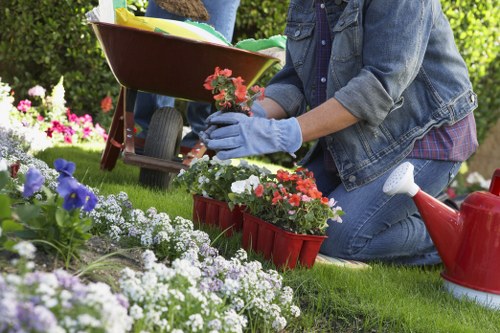 On-site sustainable rubbish gardening area practices include composting and mulching to keep nutrients local: grass clippings and garden prunings are turned into coarse mulch or hot composts to be used again on customers’ borders or donated to community plots. We maintain designated green waste bays at larger jobs so that wood, soil and turf are separated and either composted, re-used on-site or taken to authorised green-waste processors. Typical recycling activities in the area that we integrate into our operations include:
- Source-separated green waste collection for municipal or private composting facilities
- Wood chipping and re-use as mulch for paths and beds
- Segregation of packaging into dry recycling streams (paper, cardboard, glass, plastics and metals)
- Donation of reusable items to local charities and community projects
Fleet emissions are a major focus: our low-carbon vans reduce the impact of Ruislip lawncare travel. We operate an increasing percentage of electric and hybrid vehicles in our fleet, combined with efficient route planning and telematics to minimise mileage. Low-carbon vans are supplemented by trailer-based containment to reduce the number of trips to transfer stations — fewer journeys equals lower CO2 emissions. We also schedule local hubs and consolidate loads so materials destined for civic amenity sites and transfer stations are taken in bulk rather than through repeated small trips.
 We implement a practical waste segregation routine on every visit: three-way containers for green waste, recyclable packaging and residual landfill. Where boroughs provide separate food waste collections, we advise and support customers to participate so that any compostable materials can be processed by the local authority. Our teams receive training aligned with the local council's recommended separation rules for dry recyclables, glass and organics, ensuring the correct destinations for each material stream.

Monitoring, Reporting and Ongoing Improvements
Tracking our recycling performance
We monitor tonnage and diversion rates monthly to make sure we meet our recycling percentage target and to identify opportunities for improvement. Data-driven route planning and waste tracking allow us to show progress on metrics such as tonnes diverted from landfill, percentage reused locally and CO2 saved by low-carbon vehicle deployment. Strong governance means regular reviews of our partnerships with transfer stations and charities to strengthen reuse pathways and reduce disposal costs for clients while boosting social value.Community benefits are also measurable: diverted materials support local green spaces, and donated supplies foster neighbourhood planting schemes and biodiversity initiatives. We work with social enterprises that accept plantable items and furniture, turning what would be rubbish into resources for community landscaping and education projects. Our approach to the Ruislip lawn mowing market is to be resource-positive — reducing waste, lowering carbon and enhancing local green infrastructure.
As a local Ruislip garden mowing service, we ensure that sustainable disposal is integral to every job, not an optional extra. From source separation and on-site composting to handing reusable items to charities and using low-emission vehicles, we aim to create an eco-friendly waste disposal area in every garden we service. Our long-term plan includes expanding electric vehicle charging at operational hubs and increasing the proportion of jobs where >90% of material is reused or recycled.